Ian Welsh

The horizon is not so far as we can see, but as far as we can imagine

Ramadan War Could Be Decided by a Sunni Coalition

For all that Iran has been mopping the floor with the U.S., Israel, and the Gulf States, things have come to a precarious point.

While Iran has been mopping the floor strategically with the U.S., Israel, and the Gulf States, a Saudi-Pakistani military alliance could enter the fray on the U.S. side and make a difference.

This from Ian’s post of the 12th made my Spidey Sense tingle:

Pakistan used (the ceasefire) to reposition military to Saudi Arabia, and Iran doesn’t want a war with Pakistan.

That said, Pakistan’s taking a real risk here, domestically, ninety percent of Pakistanis support Iran, and the country is one spark from a revolution anyway. The army, of course, will gun down any number of civilians to retain control, but even so…

Plus the US has snared another Sunni-majority country in their military web, Indonesia:

In a joint statement, the US Defense Department and Indonesia’s Defense Ministry said the agreement reflects “decades of cooperation” and a shared commitment to peace, security, and respect for sovereignty.

“Both countries recognize each other as important partners and reaffirm their commitment to cooperation based on mutual respect, sovereignty, and shared interest in regional peace and stability,” the statement said.

Per the statement, the pact rests on three core pillars: military modernization and capacity building, training and professional military education, and exercises and operational cooperation.

Earlier Monday, US Defense Secretary Pete Hegseth met with his Indonesian counterpart Sjafrie Sjamsoeddin at the Pentagon to discuss efforts to boost the bilateral defense relationship.

Indonesia could potentially supply a LOT of ground forces for an attack on Iran, but I’m not sure their population would be into the idea.

Andrew Korybko has more on the US’ strategic aims for the Indonesia alliance:

it was reported that “US, Indonesia discuss allowing US military overflight in Indonesian airspace”, which refers to a “preliminary draft that is being discussed internally” right now, but the writing is on the wall that the US aims to leverage their MDCP to this end. The purpose appears to be obtaining the ability to blockade the Strait of Malacca to Chinese ships in the event of a crisis just like it’s now blockading the Strait of Hormuz to ships that almost all go back and forth between China and Iran.

The grand strategic goal being pursued is Under Secretary of War Elbridge Colby’s “Strategy of Denial”. The gist is that the US must do its utmost to prevent Chinese hegemony in Asia, in furtherance of which it’s indirectly controlling or cutting off Chinese resource imports (Venezuela and Iran) and seeking control over global chokepoints (Hormuz, Malacca, and the Panama Canal), with everything accelerating ahead of Trump’s trip to China from 14-15 May. Trump hopes that this will coerce Xi into a lopsided trade deal.

OR

A nascent coalition of Turkey-Egypt-Saudi Arabia-Pakistan could decide that Iran is on the verge of destroying Israel and decide to jump in against Israel to claim a big part of the prize.

The post-script of Bruce O’Hara’s most recent Substack newsletter made it all come together for me:

While it must be said that Iran doesn’t have many friends across the Middle East, many nations have depended on Iran to restrain Israel’s expansionist tendencies. The nations of the Middle East do not want the war to end with Iran destroyed and Israel intact. If it becomes clear that Israel is almost out of offensive and defensive weaponry, it would serve the interests of Turkey, Syria, Egypt, Iraq, and Jordan to gang up on a weakened Israel. Turkey’s Ergodan just today compared Netenyahu to Hitler. That’s Iran’s other hope: if they can deplete Israel enough to be relatively defenceless, Israel’s neighbours will suddenly find their courage.

Pakistan’s role as the mediator was no accident and reflects their remarkable geo-strategic positioning.

Three key facts about Pakistan to keep in mind:

  1. The current regime has limited popular legitimacy
    Former Prime Minister Imran Khan was overthrown with US backing (he attempted neutrality in the Russia-Ukraine War, his replacements sent huge arms shipments to Ukraine) in 2022 and replaced by the current regime fronted by Shehbaz Sharif. Khan, one of the most popular politicians in the country’s history was then railroaded on all kinds of charges, trumped up and otherwise, and has been in solitary confinement. Khan’s wikipedia page is an exercise in slander but the awfulness of the story still shines through. This makes it very tricky for the Shenbaz Sharif
  2. Pakistan has India relatively diplomatically isolated
    Pakistan was at war with India its fellow nuclear power as recently as May of last year and its partisans have vociferously claimed complete victory — with lots of credit being given to their Chinese-built Chengdu J-10C fighter jets. Somehow Pakistan has managed to maintain close ties with China, Turkey, AND Trump’s United States while Modi’s India finds itself on the outs with Trump, at the mercy of an angry Russia for oil supplies (costs tripled for India in March), linked to Israel’s regional pariah zionist regime, and no closer than ever to China.

Pakistan (with the strong backing of China) arm-twisted Iran into accepting a ceasefire and entering talks with the U.S. in Islamabad.

Pakistan also shipped fighter jets to Saudi Arabia. Which is a good time to think about the implications of the Pakistani-Saudi Mutual Defense Pact. DropSite News has some leaked documents:

On Saturday, as Pakistan was in the middle of mediating hard-won ceasefire talks between the U.S. and Iran, Saudi Arabia made a sudden revelation that appeared to undermine Pakistan’s status as a neutral host. In a statement posted on X, the Saudi Ministry of Defense announced “the arrival of a military force from the Islamic Republic of Pakistan at King Abdulaziz Air Base in the Eastern Sector,” adding that the force would include a contingent of military aircraft and would improve “operational readiness between the armed forces of the two countries.”

Those deployments are the result of a defense pact signed last year between Riyadh and Islamabad that has now been activated amid an ongoing regional war and numerous Iranian attacks against military and energy targets in Saudi Arabia.

The risk that Pakistan may itself be pushed into the war is also important context for the zeal of Pakistan’s leaders to bring an end to the fighting. Pakistan enjoys good ties with both Iran and the U.S., and relies heavily on financial support from Saudi Arabia. Following news that the United Arab Emirates had recalled a loan from Pakistan last week, Saudi Arabia and Qatar stepped up with $5 billion aimed at propping up Islamabad’s foreign reserves as it deals with fallout from the economic crisis caused by the war.

Pakistan has more than problems, it is in a predicament.

Note the bit about the UAE and Pakistan being on the outs.

That pairs well with Saudi Arabia’s Crown Prince Mohammed bin Salman (MBS) being at odds with the UAE’s Mohamed bin Zayed (MBZ).

The rulers of Saudi Arabia and the UAE had been very close ever since MBZ backed the palace coup that put the young MBS on the throne in the place of Muhammad bin Nayef, a CIA darling.

Together the two launched a war on Yemen in 2015 (with US backing). That war caused over half a million Yemeni civilian deaths but proved a costly humiliation for the Saudis and UAE.

After the UAE signed the Abraham Accords with Israel in 2020 near the end of Trump’s first term, it seemed that MBZ would lead his Saudi protege into signing on. That changed after October 7, 2023.

The genocide in Gaza made it politically untenable for any Muslim leader to get closer to Israel.

In the mean time, MBS and MBZ’s relationship has degenerated into open proxy warfare in Yemen. The Saudi backed forces whomped ass on the UAE’s pawns in a scrap the UAE side started with some flagrant territory grabbing.

The 12 Day War last June pushed the Saudis to re-calibrate away from the UAE, Israel and the U.S.

MBS signed a Chinese-brokered peace deal with the Iranians. The Iranians have so far left the Saudis with their pipeline to the Red Sea, a route Iran could cut off at anytime by bombing the pumping stations or encouraging their Houthi allies in Yemen to blockade the Bab-el-Mandeb to Saudi oil.

Iran could also take out the Saudi power and water desalination plants and render Riyadh uninhabitable.

That’s where the Saudi-Pakistani mutual defense pact, and Pakistani’s nuclear arsenal come into play.

IF the Sauds push the US to leave their territory then they should have no further conflict with Iran, regardless of however many Pakistani troops are on their territory. If they continue to support US and Israeli attacks on Iran, very different situation.

And so does the four way “discussion group” with Turkey and Egypt that MBS has assembled to join Pakistan and Saudi Arabia as regional power brokers.

While neither Egypt nor Turkey is a nuclear power, both are significant military powers in the region.

Both are also deeply entanged militarily with the U.S. Turkey because of its NATO membership. Egypt because of the billions of dollars of military funding the U.S. gives it as a reward for cooperating with Israel. Also the U.S. backed the coup which put President Sisi in power and overturned the post-Arab Spring elections.

But nonetheless, the four countries met in May and discussed a mutual security pact, per Middle East Eye:

Turkey has, since last year, been seeking a security pact with Pakistan and Saudi Arabia. Earlier this year, a Pakistani minister said in a statement that such a deal had been in the pipeline for nearly a year.

Turkish sources familiar with the issue previously told Middle East Eye that Ankara was also trying to bring Egypt into the arrangement. The sources said the agreement would not mirror the guarantees and commitments of Nato, but would instead serve as a security platform to enable greater cooperation in the defence industry and broader defence matters.

While Ankara has repeatedly described Israel as the primary instigator of the war with Iran, a joint statement by the participating countries in Riyadh on Thursday strongly criticised Tehran for its attacks on the Gulf.

The statement mentioned Israel only briefly, referring to its “expansionist” policy in Lebanon.

Erdogan has spent the last thirty months loudly accusing Israel of genocide and quietly supplying them with oil via a pipeline from Azerbaijan.

But since the Iran War, he has upped his anti-Israeli rhetoric, even threatening military action this weekend.

The Jerusalem Post’s coverage could be dismissed as scare-aganda, cheap theater to reassure their readership that Turkey presents a real and ever present threat and might need to be attacked at some point:

Responding to reporters later in the day, Erdogan escalated his rhetoric even further, suggesting that Ankara could choose to engage with Israel militarily.

“We must be strong to prevent Israel from doing this to Palestine,” Erdogan said. “Just as we entered Karabakh, just as we entered Libya, we will do the same to them,” he stated. “There is nothing to prevent us from doing it. We just need to be strong so that we can take these steps.”

The Turkish foreign minister got into it today:

Turkey feels increasingly encircled by growing cooperation between Israel, Greece and Cyprus, Hakan Fidan, the Turkish foreign minister, said on Monday, warning that, after Iran, Tel Aviv could turn its attention to Ankara.

Fidan’s remarks come in the aftermath of the collapse of Iran–US peace talks and amid rising tensions with Israel over regional stability. Ankara has so far remained outside the conflict in Iran but has been accused of maintaining close ties with the Iranian regime as well as its regional proxies, Hezbollah in Lebanon and Hamas in Palestine.

“After Iran, Israel cannot exist without an enemy; as you know, it has to develop a certain rhetoric,” Fidan told Anadolu Agency. The Turkish foreign minister added that both the Israeli government and some opposition figures were seeking to “designate Türkiye as a new enemy.”

Turkish President Recep Tayyip Erdoğan has accused Israel of carrying out genocide in Gaza. Israeli Defence Minister Israel Katz responded by calling Erdoğan a “paper tiger”, saying that he had not reacted to reported missile launches from Iran towards Turkish territory.

“A member of the Muslim Brotherhood who slaughtered the Kurds is accusing Israel – which is defending itself against its Hamas allies – of genocide,” he added.

Turkey’s been on a collision course with Israel since their mutual U.S. backed project to destabilize Syria succeeded all too well and put the famous Al-Jolani, ex-Al Queda and ISIS, in charge.

That added to the relentless political pressure from a Turkish population outraged by the genocide in Gaza and less and less inclined to be placated by Erdogan’s empty rhetoric.

Israel’s dominance of Greece and Cyprus gets Turkey’s hackles up and combined with the Trump regime’s attempt to entice Kurdish forces to attack Iran, Erdogan might be forced to make a real break with the U.S. and go after Israel.

Iran has choices to make but holding to a dead ceasefire while enemies and potential enemies make moves isn’t a good one.

Week-end Wrap – Political Economy – April 12, 2026

by Tony Wikrent


“A curtain of darkness is settling over our nation.”

Heather Cox Richardson, Apr 11, 2026 [Letters from an American, April 10, 2026]

It feels like something shifted in the United States this week after President Donald J. Trump threatened on Tuesday that “a whole civilization will die tonight, never to be brought back again.” As professor of human rights, global affairs, and philosophy Mathias Risse of Harvard University’s Kennedy School noted, the Geneva Conventions prohibit “acts or threats of violence whose primary purpose is to terrorize civilians.” He notes that Trump’s threat terrorized 90 million Iranians by threatening them with genocide.


Killing History — DOJ’s Office of Legal Counsel (OLC) declares the Presidential Records Act unconstitutional

Joyce Vance, Apr 08, 2026 [Civil Discourse]

…“You have asked,” it begins, “whether the Presidential Records Act of 1978 (“PRA” or “Act”) is constitutional.” The answer follows immediately: “We conclude that it is not.” There are two reasons, either of which, standing on its own, would have been sufficient to undo the PRA. The opinion explains that they are “interlocking.” The Act “exceeds Congress’s enumerated and implied powers”, and it also “aggrandizes the Legislative Branch at the expense of the constitutional independence and autonomy of the Executive.” In other words, we’re watching another power grab by this administration, a stratagem to expand the power of the executive at the expense of Congress, while claiming it’s the other way around….

[TW: I hope readers who have been here long enough will remember that in the past few years I often linked to law journal and scholarly articles debunking the conservative arguments about “enumerated” powers:


Donald Trump’s Plan To Steal Or Destroy Everything — We should assume it’s underway, starting with the Epstein files.

Brian Beutler, Apr 10, 2026 [Off Message]

Donald Trump now claims to own all of his presidential records. To be more precise, his Justice Department’s Office of Legal Counsel, which interprets law for the entire executive branch, recently opined that the Presidential Records Act is unconstitutional, and thus that any government documents that cross the president’s desk, or pertain to his work, are his to keep, unless he chooses to leave them with the National Archives….

This is bullshit because the president works for the public, not the other way around; he is no more entitled to make off with our documents than you’re entitled to charge a Ferrari to the company credit card….

…And we should suspect the worst, because this action only really makes sense as a fabricated legal defense against actions Trump and his subordinates have already taken or intend to take imminently. There was no reason for Trump to do this unless he means to make off with or destroy a large number of incriminating or valuable public records in short order—not merely at the end of his term. If Trump had sincere, above board motives, he could have challenged the Presidential Records Act in court directly, rather than make a lawless assertion of power and wait for litigants and judges to stop him. The reason an administration of such low character would do this now, years before Trump leaves office, is to begin the process of burying or destroying or privatizing records right away—many months before Democrats regain control of Congress….

Trump’s New Attempt To Keep You From Voting

Joyce Vance, Apr 06, 2026 [Civil Discourse]

Last Tuesday, Donald Trump signed a new executive order designed, to put it simply, to make it more difficult for us to vote.


War

Yes, Trump Might Use Nukes in Iran

Andrew Day, Apr 7, 2026 [www.defenddemocracy.press]

…Maybe these statements were just bluster, maybe not. Regardless, if Tehran doesn’t budge, Trump will feel pressure to follow through and turn Iran into an apocalyptic hellscape before tomorrow morning.

Moreover, Trump doesn’t seem to have internalized the “nuclear taboo,” the idea that strategic planners consider the nuclear option illegitimate and uncomfortable to even contemplate. Joe Scarborough of MSNBC reported during the 2016 presidential race that Trump had questioned a foreign policy adviser about the impermissibility of using nuclear weapons. “Three times he asked at one point, if we had them, why can’t we use them,” Scarborough said.

Trump: First of all, you don’t want to say, “Take everything off the table,” because you’d be a bad negotiator if you did that.

Matthews: Just nuclear.

Trump: Look, nuclear should be off the table. But would there be a time when it could be used? Possibly, possibly.

Matthews: OK. The trouble is, when you said that, the whole world heard it. [Then–Prime Minister] David Cameron in Britain heard it. The Japanese, where we bombed them in ’45, heard it. They’re hearing a guy running for president of the United States talking of maybe using nuclear weapons. Nobody wants to hear that about an American president.

Trump: Then why are we making them? Why do we make them?

Arguably, Trump had a point. After all, a president can’t take nuclear weapons “off the table” without thereby negating their deterrence value. Still, the exchange suggests Trump approaches the issue with less gravity and forbearance than the average world leader….

“President Trump is clearly frustrated and looking for an off ramp to end the war, but seems to want to put some kind of exclamation point on the campaign,” Jennifer Kavanagh of Defense Priorities told The American Conservative. “He’s hoping for a big win that he can use to sell the war as a massive success. This could push him to escalate, even as the returns are diminishing.”….


When War Crimes Rhetoric Becomes Battlefield Reality: The Slippery Slope to Total War on Iran.

[JustSecurity, via The Big Picture, April 07, 2026]

Iranian power plants and other critical civilian infrastructure are protected from attacks by the law of war the United States helped craft after World War II. Such an object can lose its protection only if it is used for military purposes by the enemy and its destruction “offers a definite military advantage.” Even then, such an object can be attacked only if, after a case-by-case rigorous analysis, the “concrete and direct military advantage anticipated” outweighs the civilian suffering that is expected to result.

[TW: Aa number of Democratic Senators and Congressmen declared Trump should once again be impeached. Even former prominent Trump boosters such as Tucker Carlson and Candace Owens have begun calling for the use of the 25th Amendment to remove Trump from office.

[Because the (anti)Republicans in Congress will block another impeachment, I think a more useful and effective response is to introduce and fight to pass a law making it an explicit war crime for any President — absent a nuclear attack on the US or any of its allies, or without a Declaration of War by Congress — to order the use of nuclear weapons. To maintain the deterrent capability of US nuclear weapons, this law must be explicit that it does not apply to an order in which a nuclear attack on the US or any of its allies has already been inflicted or has already begun. This is necessary to maintain US strategic deterrence.

[By contrast, this new law would clearly state that any use of nuclear weapons outside this deterrent role would be a war crime.

[The introduction and debate of this new law can be framed and managed in such a way as to force supporters of the unitary executive theory to admit that either there are limits to presidential authority, or admit that their interpretation of unitary executive theory is not even bounded by the war powers clause of the Constitution. This admission would inflict serious damage on the unitary executive theory, especially in the court of public opinion.

[This would be much more likely to attract the support, or at least votes, of Republican members of Congress, and could be used to great benefit in attacking the unitary executive theory.

[This new law should also include sturdy and robust safeguards for members of the military who refuse unlawful orders. We have already seen Trump’s vindictive attempt at retribution against the Vindman brothers during his Trump’s first term, and the threats to prosecute Senators Slotkin and Kelly, and the Congressmen who joined them in publishing a video remining members of the military their duty includes refusal to obey unlawful orders. Will a JAG lawyer who advises a commander not to obey an order be subjected to retaliatory investigations, abuse, professional damage, and even personal danger by Trump and his agents? Using the hypothetical Seal Team 6 question during the Supreme Court hearing on Presidential immunity – what if Trump orders certain military units or operatives to kill any JAG lawyer opposing illegal orders? ]


Confirmed: Trump admin threatened to overthrow the papacy

Adam Lynch, April 08, 2026 [Alternet, via DailyKos, April 08, 2026]

Pope Leo XIV chronicler Christopher Hale says he has confirmed that Trump’s Pentagon threatened to declare war on the Vatican.

“In January, behind closed doors at the Pentagon, Under Secretary of War for Policy Elbridge Colby summoned Cardinal Christophe Pierre — Pope Leo XIV’s then-ambassador to the United States — and delivered a lecture,” said Hale.

“America has the military power to do whatever it wants in the world,” Colby and his associates informed the cardinal. “The Catholic Church had better take its side.”

As the room temperature grew, Hale said he confirmed that one U.S. official “reached for a fourteenth-century weapon and invoked the Avignon Papacy, the period when the French Crown used military force to bend the bishop of Rome to its will.” ….

Citing a Free Press report, a writer obtained accounts from Vatican and U.S. officials briefed on the Pentagon meeting. According to his sources, Colby’s team picked apart the pope’s January state-of-the-world address line by line and read it as a hostile message aimed directly at President Donald Trump. Hale said what “enraged them most” was Leo’s declaration that “a diplomacy that promotes dialogue and seeks consensus among all parties is being replaced by a diplomacy based on force.”

“The Pentagon read that sentence as a frontal challenge to the so-called ‘Donroe Doctrine’ — Trump’s update of Monroe, asserting unchallenged American dominion over the Western Hemisphere,” said Hale….

The Pentagon’s January confrontation with Cardinal Pierre signals an unprecedented willingness by Trump officials to pressure religious institutions into alignment with administration goals. This represents a potential inflection point: where diplomatic courtesy once governed state-Church relations, coercion may now be replacing negotiation. The Vatican’s refusal to participate in the 250th anniversary celebration underscores that even America’s most prominent religious institution will not compromise its moral authority for political expediency.


The Public Theology We Need Now — Moral compromise is far too common, but we know a better way.

William J. Barber, II and Jonathan Wilson-Hartgrove, Apr 11, 2026 [Our Moral Moment]

In the spring of 1933, while the world faced rising authoritarian movements, Franz von Papen traveled to Rome as a delegate of Germany’s new Chancellor. There he began negotiations for an agreement between the Vatican and the German Reich – a Concordant both parties would sign that summer, preparing the way for Hitler’s regime to advance its agenda for the next dozen years without mass resistance from German Christians. The details of the agreement were spelled out in several pages, but the structure was simple, and largely reflected how most Catholic and Protestant churches would negotiate the Third Reich: churches would be free to worship, run schools, and conduct social services as long as their preachers stayed out of politics.

The pastoral ministries of the Church could continue if it silenced its prophetic critique.

When the US President threatened genocide on social media this week, Pope, Leo XIV – the first American Pope – told reporters, “This truly is not acceptable.” He encouraged US citizens to call their representatives in Congress and demand a check on the President’s war powers. This was not the first time Leo (or Pope Francis before him) challenged Trump’s agenda, but it was remarkably direct….

The central question of public theology is always what God requires of us, no matter who is in charge. Throughout history clergy have been accused of being “too political” in times and places where political leaders did not want to have to deal with the challenge our moral traditions offer. The compromise that Trump demands today and that German Christians agreed to in 1933 has been made far too often in human history. It was the basic agreement between white churches and the Jim Crow regime in the American South, between church leaders and the Roman emperor Constantine in the fourth century, and between many governments and church institutions in between.

But this is not the only story of public theology that we have inherited. Two years before von Papen traveled to Rome to meet with Vatican officials in 1933, a handful of clergy, scholars, and activists traveled to New Haven, Connecticut at the invitation of seven African-American students at Yale Divinity School who had dedicated themselves to “service and sacrifice for Christ.” The students were concerned about the authoritarian movements of their day, both in Europe and in the American South. They also knew God had called them to become leaders in the church who could work together for “the creation of a new social order based on the principles of Jesus.”

Not content to simply wait for their theological school to equip them for this moral leadership, they called on a young scholar from Howard University (Benjamin Mays), a young labor organizer (A. Philip Randolph), a couple of preachers who had built large churches in New York City and Atlanta, and a couple of PhD’s who would go on to lead HBCUs over the next few decades. Only one of their professors, Jerome Davis, helped facilitate the gathering. For a few days, the small group reflected together on this question: how could they practice the militant nonviolent love of Jesus in a way that would bring down Jim Crow? They recorded their resolutions in a document they titled, “Whither the Negro Church?,” then they set about building institutions that could operationalize their vision.

Just five years later, one of those seven students and his spouse traveled with Howard and Sue Bailey Thurman to India, where they met Gandhi and continued the discussion they’d started about nonviolence. Others who’d participated in the seminar worked together to build the Institute for Religion at Howard University, where Thurman became Dean of Rankin Chapel. Mays left Howard to lead Morehouse College, and others from this “Rankin Network” went on to teach and lead at Virginia Union, Lincoln University, Shaw University, North Carolina College (now NC Central University), and other HBCUs. But their growing network came back to Howard for regular meetings and stayed in touch through the “Journal of Religious Thought” that William Stuart Nelson, a Yale graduate, edited.

The public theology of this network did not make headlines for the next couple of decades. Most of its adherents didn’t get big book deals or respected teaching posts….

Before Martin Luther King, Jr., James Farmer, Diane Nash and many others were leaders of the modern civil rights movement, they were students at the HBCU’s shaped by this Rankin Network. There they learned a faith that demanded social action, the philosophy of nonviolence, and the hope that movements could change what seemed immovable. When he was martyred in 1968 after becoming the most recognizable moral leader of the 20th century America, Dr. King was eulogized by his mentor and college President – one of the handful of people who’d been at that initial seminar in 1931 – Dr. Benjamin Mays….


Trump decided on war with Iran after secret Israeli pitch, New York Times reports

[Drop Site Daily, April 8, 2026]

President Donald Trump authorized strikes on Iran following a February 11 Situation Room meeting in which Israeli Prime Minister Benjamin Netanyahu, appearing alongside Mossad chief David Barnea and military officials, presented a four-part regime-change pitch that included a video montage of potential replacement leaders such as Reza Pahlavi, the New York Times reported Tuesday. Netanyahu argued Iran’s ballistic missile program could be destroyed within weeks, that the regime would be too weakened to close the Strait of Hormuz, and that Mossad-fomented street protests combined with a Kurdish ground front from Iraq could trigger an uprising. Trump’s immediate response was reported as: “Sounds good to me.” Vice President JD Vance was absent, stranded in Azerbaijan. U.S. intelligence officials pushed back sharply the following day. Central Intelligence Agency Director John Ratcliffe called the regime-change scenario “farcical,” Secretary of State Marco Rubio called it “bullshit,” and General Dan Caine told the president the Israelis routinely “oversell” plans that are “not always well-developed,” the Times reported. War Secretary Pete Hegseth was described as the strongest proponent of immediate action.


Here’s A List Of Gulf Energy Infrastructure Damaged In Iran War

[Bloomberg, April 12, 2026, via gCaptain]

Ceasefire Talks In Pakistan Fail

Not precisely a surprise, given they sent Kushner, Witkoff and Vance to negotiate. Apparently Vance talked to Trump six times and Iran says that the negotiations were going OK until Netanyahu called Vance, then suddenly it seemed like the American delegation was negotiating for Israel.

More to the point, the US wanted the Strait open and for Iran to give away its enriched uranium, and Iran said “if you can’t win it in war, why should we give it to you in negotiations?” After all the damage inflicted on Iran, they need a lot of revenue to rebuild.

I remain convinced that Israel has child rape blackmail on Trump.

Meanwhile Pakistan has been moving planes to Saudi Arabia, which sure looks like a stab in the back to me, and Israel continues to bomb the shit out of southern Lebanon, wiping entire villages off the map, though it seems like Hezbollah is doing a fair bit of damage to them in return. Israel learned nothing from Ukraine and doesn’t even have cope cages on their Merkava tanks.

I’m not sure if Iran should have accepted the ceasefire or not. On the pro-side, they’re not getting bombed and the Strait is still closed and they have time to dig out damage around their underground mountain bases. On the negative side, Israel gets to pound Lebanon and Hezbollah, and the US is able to bring in interceptors and weapons stripped from the rest of the world, getting ready for the next round. And, of course, Pakistan used this time to reposition military to Saudi Arabia, and Iran doesn’t want a war with Pakistan.

That said, Pakistan’s taking a real risk here, domestically, ninety percent of Pakistanis support Iran, and the country is one spark from a revolution anyway. The army, of course, will gun down any number of civilians to retain control, but even so…

Israel’s losing pieces of the world, however. South Korea’s Prime Minister criticized Israel, and as Trump says all trade will be cut off with Spain because it won’t let the US uses bases in its territory to attack Iran, well…

What, exactly does Spain need from the US which it can’t get from China?

And as for South Korea, well, Iran lets friendly nations tankers thru the Strait? US hegemony was based, in part, on its control of oil. If it can no longer guarantee its allies the oil they need, why should they remain allies? South Korea is one of the first to make this calculation, but it won’t be the last.

This is probably why Trump is considering blockading access to the Strait himself, but countries will start sending military escorts, especially China if he does, because many countries are going to have serious problem: no cars on the road, no fertilizer for farms, no diesel for tractors, no bunker fuel for ships crises if this goes on much longer. Plus, of course, Ansar Allah will then shut the other Strait.

However much they may be scared of the US, however much they may be trained to be vassals, East Asian countries NEED Gulf Oil.

And if the US fires on escorts, well, that’s how World War III starts.

A complete clusterfuck. The only available courses appear to be a US military coup or a revolution, neither of which seems likely. If Congress wasn’t completely compromised, they’d have already impeached Trump, so there is no legal solution.

Or the US or Israel may nuke Iran. This is already being normalized, with Mark Levin suggesting the situation is similar to Japan: drop a couple nuclear bombs to convince them to surrender.

The difference is that Japan had already lost the war conventionally, and Douglas MacArthur, among others, thought that they would have surrendered with the nuclear bombing. Iran has not lost conventionally, and they have retaliation ability against Israel. They can:

  1. Destroy the desalination plants that provide 80% of Israel’s drinking water;
  2. Hit the Dimona Nuclear reactor causing a containment breach which would make Israel uninhabitable; or,
  3. Make dirty bombs with their 60% enriched uranium. One gets thru, and Israel is, again, uninhabitable.

Iran doesn’t need nukes to destroy Israel. I hope someone has forced this knowledge on both Trump and Netanyahu. So far the Iranians have fought a very moral war, as such things go, but if they get nuked, one of those thirty-two mosaic commanders is going to retaliate hard.

Really tiresome watching the world’s stupidest people screw everything up because many of them felt the need to rape girls in houses rigged for video by the Mossad.

Everyone reads these article for free, but the site and Ian take money to run. If you value the writing here and can, please subscribe or donate.

Open Thread

Use to discuss topics unrelated to recent posts.

American Profits Are One Of The Causes of American Decline

Stumbled upon this chart of US corporate profits vs. corporate taxes. The important part isn’t the taxes, it’s the profits. (Note that this is nominal and doesn’t include inflation adjustment, not that American inflation numbers mean anything anyway.)

Now let’s look at another chart. This one of his how much profit companies that produce actual products (aka. not finance, insurance and so on) make per dollar of GDP added.

Notice that the long term rate through the “good” period of American prosperity (where there was a huge middle class and wages rose at the same rate as productivity) is pretty steady, and never goes above about 13cents to a dollar. It starts rising around 76 (Carter, who was very neoliberal)and continues a sustained rise, with a huge spike after Covid.

What you see in America are constant fears of inflation. Every single BLS adjustment to inflation rate measures that I am aware of since 1980 has had the net effect of reducing stated inflation. The real inflation rate in America is massive.

Meanwhile, in China, the constant fear is deflation.

Why? Because China has competitive markets and America does not. Barriers to entry are high, and everyone is looking for high profits thru barriers to competition. American firms took economic studies that showed that in competitive markets profits were low and spent all their time trying to make markets un-competative so they could have high profits. This mostly meant capturing government, because it is government regulation and enforcement which keeps markets competitive.

China wants competitive markets in most sectors, except those which provide public goods. They are aggressive about it. Chinese firms compete on quality and price and often engage in price wars, so much so that sometimes the government steps in to stop them from driving themselves bankrupt. Last time I checked the the EV manufacturing market I found over a hundred companies. The competition is savage.

So Chinese companies have low prices, “over production” and constantly introduce new models and products to try and either increase quality or price. Tesla goes years between new models, Chinese companies sometimes introduce multiple new models a year.

Everyone wants to get a share of high US profits, that’s one reason why money floods into the US. But US companies have become uncompetitive. They keep effectively shrinking: more profits, sure, but only by slowly, then quickly, destroying the companies. This is why the US has 100% tariffs on Chinese EVs, if they let them in at all. And now they’re losing their foreign markets, as Europeans and Canada start letting in Chinese EVs.

The story is similar in most industries. America and Europe can’t compete. Period. Because instead of trying to be competitive, they’ve tried to create non-competitive markets and then soaked their customers as hard as possible. This works, till there isn’t any competition, or until you destroy your customers, who are also your employees, because US companies have also been keeping wage increases for everyone except executives and a few key employees (used to be programmers, but they’re about to get it in the neck) below price increases.

And this is how you wind up with 50% of all spending being done by 10% of the population, making most of America’s population economic cripples. It’s why you can’t afford tickets to a rock concert or a sports game, even though those were once solidly middle class pursuits and affordable to the poor.

This is a specific example of a general rule that you can always extract more profit if you’re willing to drive your company or your country into the ground.

About 20 years ago I wrote an article titled “there was a class war. The rich won.”

They’re still winning, but by doing so they have destroyed America’s place in the world, and indeed, the entire West’s. Hundreds of years of Western dominance are coming to an end because these greedy bastards wanted high profits for fifty years, and didn’t care what they did their country or most of their fellow citizens.

Everyone reads these article for free, but the site and Ian take money to run. If you value the writing here and can, please subscribe or donate.

The Twin Pillars of the Interregnum of Unreality Are Under Stress

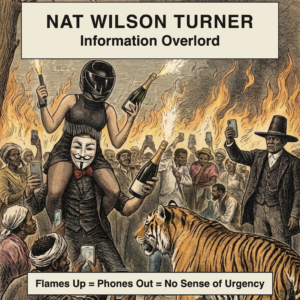
Guest Post by Nat Wilson Turner

Last Fall, I posited that the US and greater West are in the grips of an Interregnum of Unreality that began when Barack Obama successfully papered over the Great Financial Crisis while addressing none of the causes and leaving the very same banksters whose antics caused the crisis in place.

The Interregnum of Unreality is the legacy of Barack Obama who achieved near-total information dominance via traditional and social media and used that power to promulgate a message that everything was fine, nothing ever happens, the neo-liberal order will never end because it rests on two indestructible pillars:

  1. The perception of American prosperity
  2. The perception of global American military dominance

Thanks to Trump’s impericidal decision to attack Iran in February, kicking off a war he can’t TACO out of, the reputation of American invincibility has taken a beating.

The estimable Aurelian writes in his latest missive of the global political implications of the ass-whipping the American military has taken in the Ramadan War:

That hit is going to be all the larger because of the massive, orchestrated PR campaign that has been going on for more than a generation, presenting the US as the Empire and the Hegemon, its military the unstoppable colossus trampling small countries underfoot. But the test of a hegemon is not how loudly you shout, but whether you can in fact do what you claim. In spite of defeats in Iraq and in Afghanistan, and the ignominious scuttle from the Red Sea, both boosters and critics of the US have been prepared to believe the US had that much power until the last month or so. But now we have price discovery, and it turns out that the US has large and quite capable forces, but it’s not the unstoppable giant ogre that it claimed to be, and never was. The whole “hegemon” thesis, people are beginning to realise, was smoke and mirrors all along: it’s just that now it’s obvious. It’s not just how it is now, it’s how it always was: a traditional result of wars, after all, is to reveal the truth about militaries. No doubt even as I write, pundits are busy composing apologias along the lines of “well, of course by hegemony we just meant Quite a Powerful Nation with a Large Military, actually.” But overselling and underperforming will have their usual political consequences.

He also brings in the second pillar of our interregnum of unreality, the markets:

There’s an interesting comparison to be made with the “Artificial Intelligence” racket, which was similarly hyped, and also expected to somehow guarantee world-dominating status for the US. But in quiet corners away from the hysteria, people who know what they are talking about have been pointing out for several years now that “AI” is a scam, that as an industry it will never be profitable, and that the money, and even more the power and the infrastructure needed, will never be available. And just in the last few weeks, the media are discovering that that’s how it is, and indeed that’s how it always was, if you had bothered to do a few sums. We can add the interesting rider, however, that in a world where generating power is going to have to be rationed, and silicon chips may be scarce, the “AI” scam may come to a swifter and more brutal end than even its worst critics supposed. Exactly what that will do to the US economy I’m not qualified to say, but I imagine it won’t be pretty.

And the damage will not just be financial. Most of the big names of international business, the Musks, the Zuckerbergs, the Altmans and the rest of that lot, treated with fawning reverence by the media and governments of the world, and who have persuaded us that what they think is actually important, will turn out to have empires built on not very much. How badly the poisonous mixture of world depression, financial crisis, and shortage of power and chips will hit them I don’t think anybody knows, but if they survive, their image, and that of the US as a technological leader, will have suffered as badly as the image of its military.

Earlier this week I posted at Naked Capitalism about the deep ties between OpenAI, Oracle and the UAE and that there are indications they are deepening those ties even as the foundations of their partnership are being lit on fire.

The weak links in the AI boom and the Middle East — OpenAI, Oracle, and the United Arab Emirates (UAE) — are strengthening their ties even as the Ramadan War exposes their increasing vulnerabilities.

Spoiler alert: Despite OpenAI’s jarring strategic shifts last week, the UAE is still pouring money down that hole.

Is reality finally intruding on our generation-long delirium?

When Trump failed to calm the markets last week with his ridiculous address to the nation, it seemed that a little reality was peeking through the veils.

But when Iran joined Trump yesterday in claiming that the basic terms of a ceasefire and ensuing negotiations had been reached, the markets roared their approval, with American equities markets posting huge gains.

This despite the ceasefire never taking place and the Strait of Hormuz only being open for a few hours.

As I attempted to document in a post earlier today at Naked Capitalism, “cognitive dissonance and conflicting agendas among key players” has allowed the western media to engage in an orgy of chatter about this ceasefire that never was even as Israel, Iran, and reportedly the UAE all launched strikes at civilians and industrial infrastructure.

One hopes that Trump realizes he went too far in his genocidal threats to destroy Iranian civilization and will at least refrain from implicitly threatening to nuke Iran going forward.

However it’s almost certain he will attempt more attacks on Iran involving US ground forces and equally certain that those attempts will end as disastrously as his first.

We’re seeing a full-on anti-Trump mutiny from leading MAGA media figures and even 70 of the senescent US House Democrats are calling for Trump to be removed from office because Trump’s rhetoric freaked the American mainstream the fuck out.

Democratic 2028 aspirants Rep. Ro Khanna and Sen. Chris Murphy both capitalized on the Trump-triggered panic and ensuing TACO to raise their profiles. Most of rest of the Dem 2028 aspirants have been caught flat footed, trapped by their zionist obligations and inability to recognize the political moment.

The freakouts and cognitive dissonance will continue until they can’t.

And as Aurelian pointed out, the consequences of the Interregnum Ending will be serioius:

For the US, as I’ve indicated, the shock is likely to be existential: Americans have been so misled for so long by their governments and media about their economic and military strength that the sudden discovery of its limits will be brutal and de-stabilising. Above all, a political culture of entitlement, which is used to issuing demands and threats to try to get what it wants, will suddenly have to cope with the US becoming the demandeur, as it is over the current “ceasefire,” obliged to make compromises and sacrifices to get what it needs to keep the country going, and seeing others expand into the strategic space it has vacated. Whether the current political system will survive the shock, and whether it will be capable of actually making the concessions necessary for survival, are very open questions.

Meanwhile the majority of Americans are getting their faces vigorously rubbed in the litter box of reality every time they pump gas and soon the inflationary impact of Trump’s war will resonate throughout the economy.

The longer it takes for the official narrative to adjust to new circumstances, the longer the Interregnum of Unreality continues, the worse the impact will be and the bigger the looming revolutionary moment will seem to be and the more forceful the ensuing crackdown will need to be to snuff it.

Twenty-One Simple Facts About the Iranian War

Update 3: Attacks continue on Lebanon and Iran, from Israel. Iran let two ships thru, then closed the Strait again. The original announcement from Pakistan said that Lebanon was part of the ceasefire, but then Israel said it didn’t, and now Trump says the same.

As ceasefires go, this isn’t one. I’ll probably write a new article when the situation becomes more clear, but so far the “Israel has Trump on a leash” hypothesis looks strong and the “Iran will not agree to a ceasefire” point looks like only needs to be modified to “no ceasefire is possible until Israel is beaten into the ground.”

Update: I’ll leave this up, but there’s a ceasefire, which I didn’t expect. Three possibilities:

1) Iran is getting the deal it wanted, and won the war.

2) They’re making a mistake.

3) Quite possible that Israel blows the ceasefire up.

Update 2:

This is Iran’s statement, if Trump did agree to all of this Iran just won:

In this plan, America is fundamentally committed to guaranteeing non-aggression, the continuation of Iran’s control over the Strait of Hormuz, the acceptance of enrichment, the lifting of all primary and secondary sanctions, the termination of all resolutions of the Security Council and the Board of Governors, the payment of Iran’s damages, the withdrawal of U.S. combat forces from the region, and the cessation of war on all fronts, including against the heroic Islamic Resistance of Lebanon.

However Israel has said they will not cease attacks unless Iran opens the Hormuz, and they will continue attacks in Lebanon. In principle the agreement is between the US and Iran, and doesn’t include Israel, so Iran could just re-target all the drones and missiles which would have been used to America and Gulf States to Israel. Given Israel appears to be withing a few days of running out of interceptors, I think it’s clear who’d win that. I hope they do, and don’t abandon Lebanon. If they do, we’ll see how much control Israel has over Trump.


First, the war was started by America and Israel, not by Iran. There was no threat from Iran. This makes starting the war a war crime, the same crime for which many Nazis were hung at Nuremberg.

Second, there is no evidence that the Iranians had or were trying to get nuclear weapons. This is the consensus of the American intelligence community, who were under ferocious pressure to find otherwise.

Third, every person who condemns Iran without noting that that America started the war discredits themselves.

Fourth, every person who condemns Iran’s attacks on Gulf States without noting that the reason those states are being attacked is that they allow the US to launch attacks from their territory, discredits themselves.

Fifth, Iran has clearly stated that all the Gulf States have to do to stop being attacked is to stop allowing attacks from their territory and stop allowing Americans to have bases there.

Sixth, by both international law and by common sense, if you allow attacks on a third country from your country, you are a co-belligerent, whether or not your own military is involved. This matters specifically because the closer air power is to where they’re bombing, the more often they can bomb. The bases also matter because they hold (or did, till the Iranians destroyed most of them) communication and radar systems which aid America.

Seventh: If the Bushehr nuclear plant has had missiles land as close as the auxiliary building. The Russians have taken the threat so seriously that they have withdrawn their technicians. It is on the coast and if there is a containment breach, given the prevailing winds, fallout will contaminate the Persian Gulf. This will end desalination, which is how the Gulf nations get almost all their drinking water. It is also likely that the radiation will make the UAE and parts of Oman uninhabitable. All the oil from those regions will never be usable again.

Notice that such a containment breach will damage America’s allies far more than Iran. The map above is only partly accurate, the winds change and often blow south or west and not just southwest. Iran does have blocking mountains which should protect it quite a bit, but radiation is nasty stuff.

Eighth: Iran is capable of entirely destroying Israel. If nuked and possibly in the case of a containment breach, the majority of their arsenal will continue to exist. It is almost all hidden in deep underground mountain missile bases. In such a case Iran can retaliate by:

  • Destroying Israel’s desalination plants, which provide 80% of the drinking water;
  • Hitting the Dimona nuclear reactor and causing a breach would render Israel (a very small country) uninhabitable; or,
  • Iran has enough 60% enriched uranium to make dirty nuke bombs and send them by missile. Once again, this would make Israel uninhabitable.

Iran does not need nukes to destroy Israel. It can do so any time it chooses and this is a fact which American and Israeli planners seem to discount. Iran is a fairly ethical nation as nations go, and they also don’t want to kill Palestinians and Lebanese. But there are 32 Mosaic commanders. If Tehran is nuked, well, all it takes is for one of them to decide to get revenge.

Ninth: At this point Iranian missiles are getting thru a lot, because interceptor stockpiles are depleted. Claims of high interception rates are as believable as similar Ukrainian claims.

Tenth: it is not possible, absent perhaps dropping many nukes, and perhaps even then, to take out Iran’s ability to launch missiles. And even then if any are left, well, it won’t take many to wipe Israel off the map.

Eleven: Iran is not going to sign a ceasefire deal, because they know that Israel and the US will keep assassinating their leaders and eventually launch another war. Well, I was WRONG. I suspect Iran’s making a mistake, but we’ll see. Iran is saying Trump accepted their 10 point proposal, if so Iran won the war and this ceasefire makes sense.

Twelve: There can be no peace deal which leaves the US any bases in the region, because the US is, to use the delightful Russian phrase “agreement incapable.” The US has never kept any agreement it didn’t feel like keeping and it certainly won’t do so with Iran. Any promises to never attack again and stop assassinations cannot and will not be trusted by Iran’s leadership. This means Iran must win the war decisively, in a way that makes it as difficult as possible for the US to attack again (no bases in region) and Israel too scared to do so because they know any attack or assassination will mean immediate and savage retaliation.

Thirteen: The Iranians have included Lebanon and Hezbollah in their demands: Israel will have to withdraw from Lebanon and stay out and not bomb it ever again. Again, this is a maximal goal and requires a complete victory.

Fourteen: Iran is never giving up control over the Strait of Hormuz. This is especially true now that their industry and civil networks have been hit hard. They will need a lot of money to rebuild. They have also said they want reparations. I don’t think that will happen, but I could be wrong. The more damage the US and Israel do, the more Iran is incentivized to use Hormuz as a lever to get money.

Fifteen:  A side effect of this war is that weapons stockpiles have been drawn down from the entire world. There was  never any possibility of the US winning a war with China, there is no longer any possibility of even fighting such a war.

Sixteen: None of the weapons being used up can be replaced in any significant numbers without Chinese materials, and even if China cooperates it will take at least a decade to rebuild credible stockpiles.

Seventeen: Iran has pushed the Americans back significantly. Their sortie rate has dropped, and they are running out of stand-off munitions. That means they have to fly closer and risk their planes, and if they insist on using Gulf bases they risk planes being destroyed on the ground, as has already happened.

Eighteen: Carrier groups have been forced back to maximum range. They are no longer the Queens of the Sea, and it is not credible that they could be used against China or Russia, both of whom have longer range missiles and in the case of China, enough to simply deplete the entire carrier group’s interception missiles.

Nineteen: Barring the use of nukes, Iran will win this war. The longer it takes and the more damage that is done to them, the more they will use their control of Hormuz and their ability to hit any Gulf State, to obtain the needed reconstruction funds and assistance.

Twenty: Internationally this war is the end of the American global Empire. Everyone knows how to defeat them now. They will retreat to the Americas and try and push around local states. China and Russia are big winners, Europe’s deindustrialization will accelerate and Europe will continue its descent into a meaningless backwards and poor region.

Twenty-One: The economic impact of this war, even if it stopped today, would be bad enough to cause a major worldwide recession. If it continues, we will see economic devastation which will last for years. There will be famines. There will be brown outs and blackouts. Jet travel will only be for the wealthy. International trade will crater due to lack of bunker fuel and most goods will rise in price and/or become rare, how much so depending on where you live. Price increases will be much higher than necessary in the Anglosphere, in particular, as oligarchs use the excuse to jack up prices even more than they need to and governments do nothing to stop them. The AI bubble is most likely toast. Oh, and prices of all devices with chips in them are about to soar throught the roof.

***

This was and is a stupid war which neither Israel nor America should have ever fought. It is an endless series war crime, with deliberate and extensive attacks on civilians and repeated genocidal threats. It has demolished what little credibility remained in the West, as leader after leader condemns Iran and somehow leaves out that America started the war and that Iran’s attacks on infrastructure were retaliations after their infrastructure was hit. It is going to cause economic catastrophe, kill millions from hunger and power disruptions, and if Trump goes completely insane it could lead to the end of Israel and Iran both.

I’ve always said the stupidest war in history was World War I, the “Great War.” But this one may wind up taking the crown.

Finally, if the US had a functioning government, Trump would be impeached or removed under the 25th amendment. It does not, and this war has made that clear. There is no possibility of making deals with America and the only sane policy for every nation in the world is to disengage economically and militarily as quickly as they can while trying to avoid an American attack.

(A small laugh after a grim post)


Everyone reads these article for free, but the site and Ian take money to run. If you value the writing here and can, please subscribe or donate.

Trump Really Messes Up Smart People

Smart people can’t handle Trump. He say something, or does something. On the face, it seems stupid, so they go into pattern matching over-drive, looking for a reason.

You see it with the “they’re attacking Iran to screw up China’s access to oil and because America has so much oil and natural gas now.”

Well, yes, but the US is near peak unconventional oil and natural gas, production will soon start declining and the collateral damage from the Iran war is so severe it’s going to send the US into a recession so severe it’ll look like a depression, because it isn’t just about oil, it’s about fertilizer and helium and supply chains being completely wiped out.

It might be that this is Trump’s “plan” and it’s just a stupid plan, but if that was it, he’d have drawn back when it became clear that the attempt to replace the Iranian government with a compliant one, a la, Venezuela, had failed.

Or we have this:

I’ve been following Marins for a while, and she’s a smart gal. But that’s the problem. Smart people look for patterns, and assume people have goals that make sense to them.

Trump doesn’t have goals like that. You just have to listen to his word salad speech. He’s incoherent, almost certainly suffering from dementia, and to the extent he has goals they are goals like “feel good” and “have people praise me” and ‘never be seen to lose.” I dislike psychoanalyzing public figures, but he’s almost certainly a narcissist

Smart people can’t handle this. There’s got to be a smart plan hidden somewhere in the word salad.

Sometimes there is, but it’s never Trump’s plan, it’s the plan of someone who has some influence over him. But that doesn’t matter, however smart that plan is, Trump will fuck it up, because Trump will never leave someone else alone to execute, he’ll always interfere. There’s a smart plan for tariffs, for example, but that was not going to happen with Trump deciding tariffs on the fly and depending on which foreign leader he was upset with that day, nor with him insisting on undoing all the industrial policy Biden’s people (not Biden, but his people, because he would leave them alone to execute in many cases) had put in place.

Trump’s just an old, sick, stupid man with dementia and so evil that Jeffrey Epstein, of all people, wrote:

“recall ive told you ,, I have met some very bad people ,, none as bad as trump. not one decent cell in his body.. so yes- dangerous.”

There is no clever plan. There never was one. There never will be one. Trump has morally neutral virtues, or did, like the ability to manipulate people, a certain type of charisma and before his decline, massive amounts of energy. The primary difference between the first Trump term and the second is that his health has declined severely and his dementia is far more advanced.

But coherent plans? No. Trump, even when he was much younger and healthier, managed to drive a casino into bankruptcy.

A casino.

There is no plan and no, not even the deep state can carry out a coherent plan thru Trump. Even Netanyahu, who has him by the short-and-hairys, only has partial control, and certainly not day to day operational control.

If some random stranger talked like Trump you’d assume he was mentally damaged and you’d be right. His being President doesn’t change that.

Everyone reads these article for free, but the site and Ian take money to run. If you value the writing here and can, please subscribe or donate.

Page 1 of 505

Powered by WordPress & Theme by Anders Norén